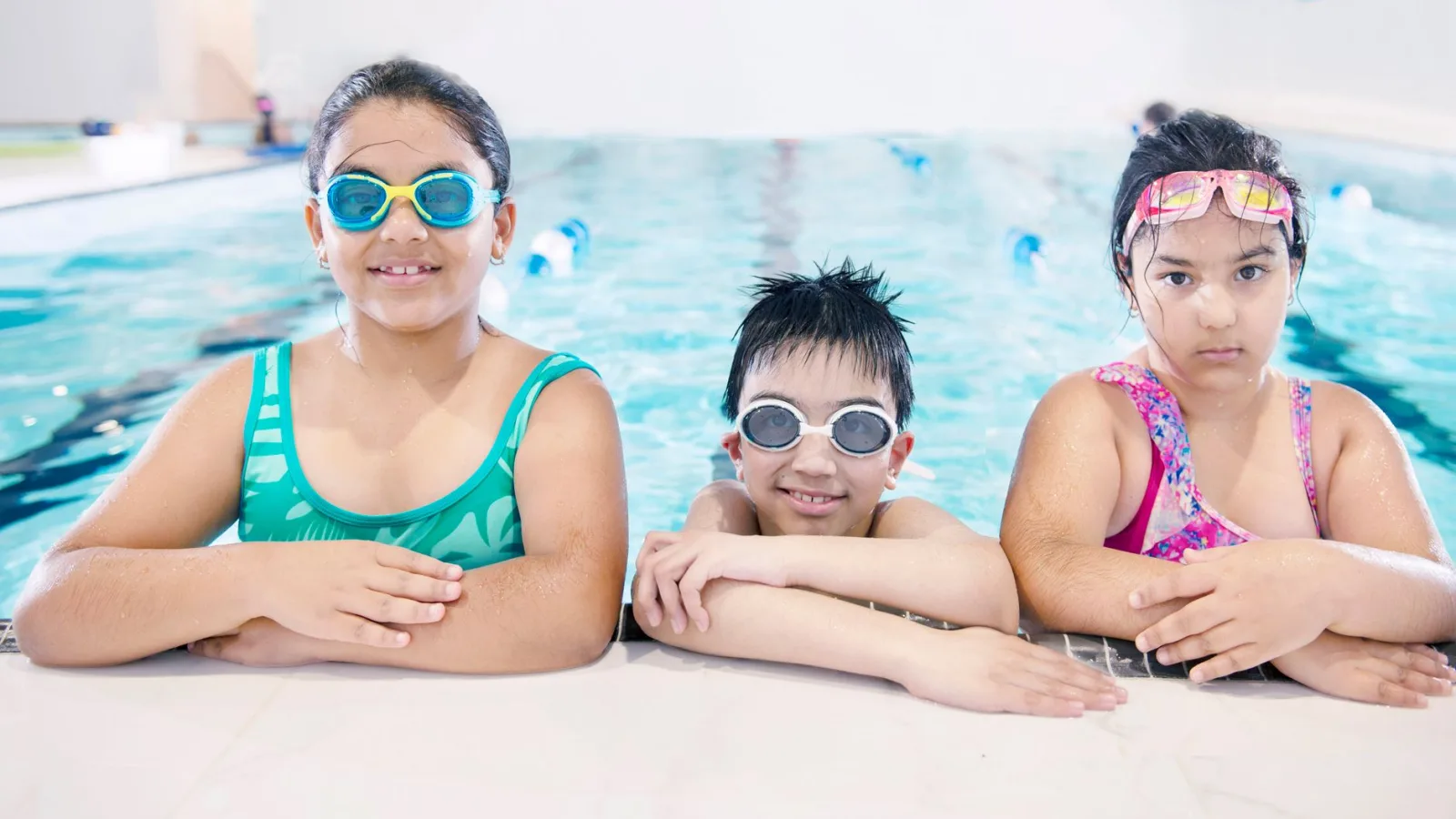
Children at English primary schools with a higher proportion of pupils on free school meals are significantly less likely to leave able to swim 25 metres than those at less disadvantaged schools, new figures have revealed.
Research by the BBC found that while 72% of Year 6 children on average left school able to swim 25m in 2024-25, this dropped to just 55% for schools with a higher proportion of disadvantaged pupils.
The figures, obtained through a Freedom of Information request to the Department for Education, also showed that 70% of Year 6 leavers nationally could on average perform a safe self-rescue, but this fell to just half of children at schools with the highest level of free meal eligibility.
A safe self-rescue, as defined by the national curriculum, includes being able to tread water for 30 seconds, float on the back for 60 seconds and swim 15m to exit the water unaided. The curriculum states that by the time they leave Year 6, all pupils should be able to swim competently over a distance of at least 25m, use a range of strokes effectively, and perform safe self-rescue in different water-based situations.
The data showed wide variation between individual schools, ranging from none of their Year 6 pupils meeting the 25m swimming target to others where all pupils did so. Only 38 schools in the highest category for disadvantaged pupils met the swimming target, compared with nearly 400 schools with the lowest proportion of children on free school meals.
Most school groups receive only six weeks of 30-minute swimming sessions to learn basic skills, amounting to just three hours of tuition in total.
Ashley Jones, head of water safety and education at the Royal Life Saving Society (RLSS), said it was "absolutely vital" that children were equipped with basic swimming and self-rescue skills. He said accessibility remained one of the biggest barriers to swimming education.
"We've got some incredible public leisure facilities, just not enough of them," he said. "That means people have got to travel further. Then you are dependent on public transport, which can be costly, and access to a swimming pool in terms of cost and time is still really challenging."
Some schools have sought to address transport costs through alternative arrangements, including a pop-up swimming pool set up on school grounds in Derby.
Jones said swimming lessons needed to be "universal, engaging and accessible" and called for "a fully funded, fully supported, high-level learn to swim programme" supported by wider water safety education.
Bethany Harris, a swimming teacher based in Hampshire, said it was "really tough" to teach children a life-saving skill in such a short time, particularly those with limited prior access to swimming. She said school swimming lessons should begin much earlier.
"Ultimately, in three hours you can't take someone from being a nervous swimmer to confidently being able to swim 25m with a stroke that is calm and is going to keep them safe," she said. "I think it needs to come in basically as we're teaching them to read and write in the infant school."
Harris lives close to Hawley Lake near Farnborough, where a 14-year-old died in May after going missing while swimming. "Even being inland away from the coast you've got dangerous water all about," she said.
The findings come after a number of water-related deaths this summer, including that of an 18-year-old man who died after getting into difficulty at sea at the weekend in East Sussex.
The BBC's analysis also found that the bottom fifth of local authorities for the average proportion of children able to swim 25m were all urban areas. Only four of the 31 lowest-performing council areas were coastal, with the remainder landlocked. Overall, fewer children in urban areas could swim the required distance proficiently than those in rural areas, and fewer than two-thirds of Year 6 pupils at urban primary schools could perform a self-rescue.
Harris said she would like to see leisure centres do more to make swimming affordable for families. "Ten years ago, there used to be a summer scheme where you could swim for £1 all summer long through some leisure centres," she said. "I haven't heard of anything like that happening locally these days."
A Department for Education spokesperson said the department was aware of the gap and that it "needs to change". They said a new PE Partnership Network would help address the disparity by bringing together schools, local clubs and national bodies such as Swim England.
"This means targeted support for the areas and pupils who need it most, so that every child, wherever they live, gets the same chance to learn to swim," the spokesperson said.
A spokesperson for Swim England said the organisation was working closely with the government to support the delivery of school swimming lessons. "Swimming is a life skill, not just a sport, and every child should have the opportunity to leave primary school able to swim and be safe in, on and around water," they said.
"However, schools have faced significant pressures in recent years, particularly those serving disadvantaged communities, including competing curriculum demands, increasing transport costs and access to suitable swimming pools. These challenges are real, so it is more important than ever that there is a collective approach to helping children gain a skill that could one day save their life."